
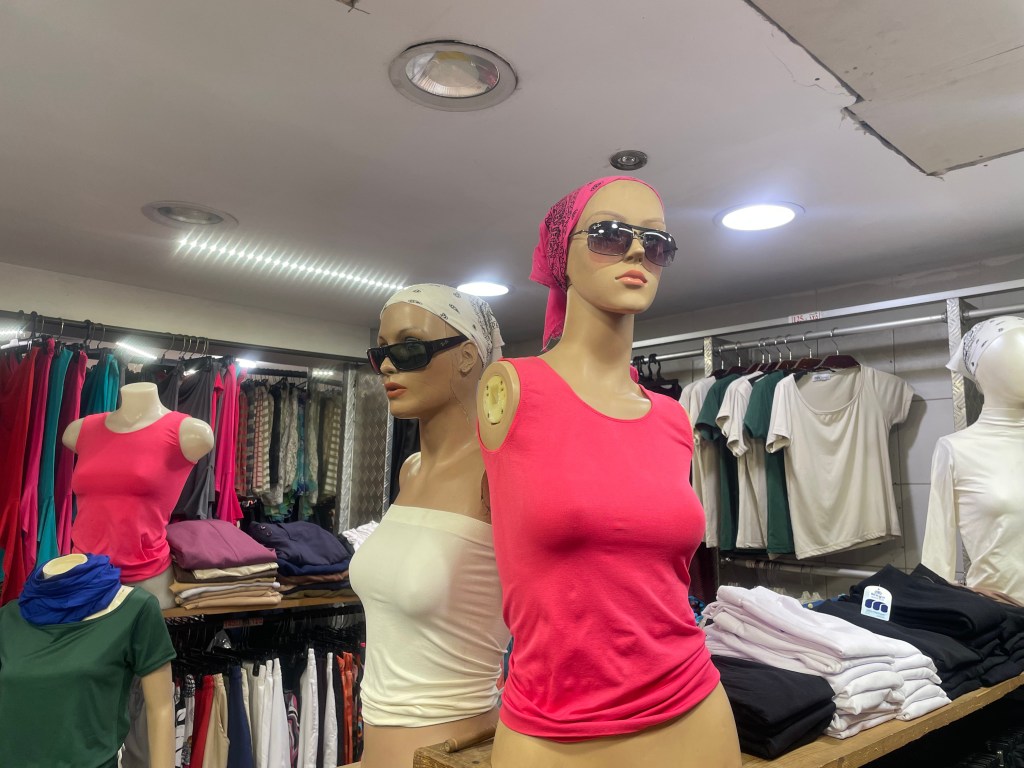
Walking up to S. Khomaeis’s shop, you’ll first come across old-school wooden box crates sitting outside the entrance brimming with clothes, awaiting the eager shopper who is ready to roll up their sleeves and take a plunge. Inside, the store vaguely resembles a sardine box, made entirely out of reflective aluminium lining its four walls. It’s something you would expect of a dodgy Harlem consignment shop intermarried with a zany art installation, equal parts enthralling and puzzling.
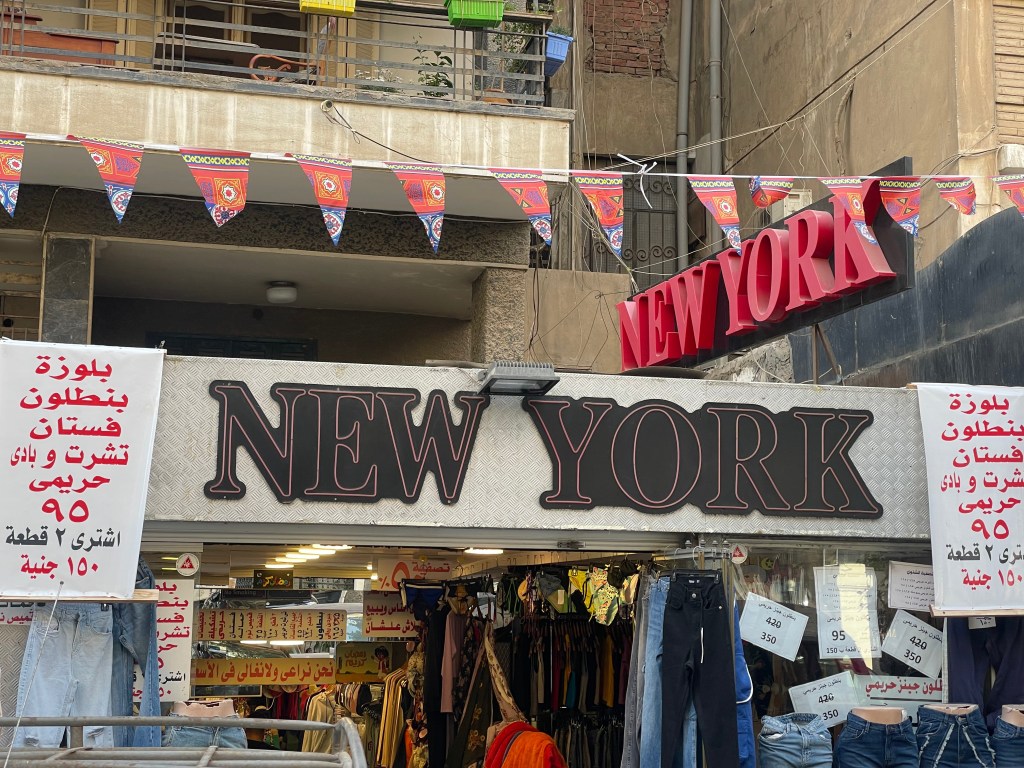
Khomaies himself looks equally as compelling as the store, often found dressed in patterned pants, trench coats, and snappy sunglasses despite his older age. “My dad is a very beautiful man inside out. Blue eyes, white hair. He wears a crimson red bandana even at 70-years-old. Even though I’m younger, I don’t even express myself through my clothes as much as he does,” his son K said. But if you were to ask Khomaeis himself, and he wouldn’t describe his style in any particular way, just that he wears “anything that suits [him], whether it costs EGP5 or EGP3000.” Were it left up to us to describe his personal style, though, we would say that it’s achingly cool. It is precisely his blasé attitude that inspires his outfits and designs, and ultimately the entire soul of his store, ‘NEW YORK’.
New York has long been considered the capital of the American dream, a subjective reality that calls on everyone of all colors and backgrounds to reach for the stars while remaining true to their roots. Whether that reality is grounded in truth or not is besides the point– because it is an irrefutable actuality in the world of S. Khomaeis.
After coming home from Germany in 1986, Khomaeis founded his own version of the Big Apple in Cairo. A kitschy, homegrown clothing store catered to, well, everyone (much like the city itself). His alternative, unabashed take on style has since made him the granddaddy of underground kitsch unbeknownst to anyone up until now. When asked about the choice of the store’s name during our phone call, his son K casually starts serenading ‘New York’ by Alicia Keys and Jay Z, before eventually reverting back to the question. “It was back in the days, ‘Amrika shikabika’ and all. Everyone was obsessed with New York and everything American, so he thought it would be appealing. It wouldn’t be cool to do that now though, because we are finally switching over from 3o2det el khawaga to actually being proud of our Egyptian roots. I think now the name of the store is just something my dad doesn’t notice anymore.” But although he may not notice it, the name still bears allusions to the store’s evergreen commitment to everything sui generis.
Long before the birth of the local micro-brand operating out of the designer’s bedroom and selling exclusively on Instagram, Khomaeis was championing local production, fair prices, and self-expression before any of Cairo’s young, cool cats were even born.
One look at the ads on your Instagram feed or favourite blogger’s profile will buy you a one-way ticket down an endless pool of new, provocative emerging labels. It’s those same brands we often look to when we talk about the newfangled fashion tide washing over Egypt, the beginning of a baby industry that has no more than a handful of established international brands and a scurry of eager, creative youth desperately hoping to accomplish something for honour and for country. And then there’s Khomaeis, peering over at them knowingly and watching it all unfold from his Heliopolis store.
At the start of all this, he had two missions: to create fresh, unique designs, and to convince everyday Egyptians to actually wear them. “This all started in Italy where I learned how to cut and design. I knew that people in Egypt were financially struggling, and also that few people had the nerve to wear something out of the ordinary. I was the first person in Egypt to release a bedazzled mens shirt. I was the first to use sequins on blouses. I was the first to make a clothing store that you could come just to look at, because it looked different, not just a place to come buy things from,” the New York founder and designer said of his quirky store design.
That same disregard for visual law and order is mirrored in the brand’s online presence. One quick glance at the store’s Instagram page will leave you questioning what you just saw. Their feed is an unlikely amalgamation of street shots, family pictures, and miscellaneous items. One post in particular has nothing to do with the shop at all; a video of a man doing a wheelie on a motorcycle. “That motorcycle video shows the real Egypt, the people who have nothing. They are doing something beautiful but extremely dangerous, because they have nothing to lose. We want to support them, especially as a privileged class that they wouldn’t have expected to support them,” K explains. Alongside spunk, compassion is also a recurring theme in the ‘NEW YORK’ manifesto, which is precisely why they price their items so moderately. A shopping trip at the Roxy Square store with one grand in hand would be enough to fill up your closet. One shirt would run around EGP22– an unheard of deal in the majority of Cairene retailers. “We don’t overprice our products. We don’t have this money-focused business agenda, we just follow our gut. We don’t use any kind of digital system either. My dad doesn’t like them. He doesn’t work with computers— he is the computer,” his son added. It’s not just an abandonment of commercialism that informs their friendly pricing, but it’s rather all part of a larger agenda to integrate fashion forwardness into everyday Egyptian homes.
“He’s a born salesman, he’s talented. If you give him a rock, he’ll flip it and find something to give you. If he had a better education, he would have been Sawiris.” According to K, it’s not a formal education that made his father so good at what he does, it’s grit paired with a great deal of passion. “He’s always been into fashion. Although he has no formal design background, he’s learned through practice. He has a good eye. He doesn’t even need to do measurements, he can do this in his sleep,” he said.
Naturally, a love for fashion seeped into their home life. The same fervour for creativity runs in the family, with Khomaeis’s two children pursuing marketing and homeopathy, and his wife being an accomplished painter and sculptor. K recalls entire Euro trips in his childhood dedicated solely to shopping. But while that may be K’s story, his father’s European escapades are a little more meaty.
Khomaeis’s European adventure started at age 17 when he sold his telephone, a pricey item back in the day, and bought a plane ticket headed to Italy. He went to see his brother, one of 32 siblings he had, and ended up staying there for two years. In true Italian spirit, he learned about himself, life, and in true Italian spirit– about fashion. It wasn’t long after that he trotted across the continent to scores of cities and even more jobs. He called it quits eventually, heading back home to actualize his aspirations in the late 80s.
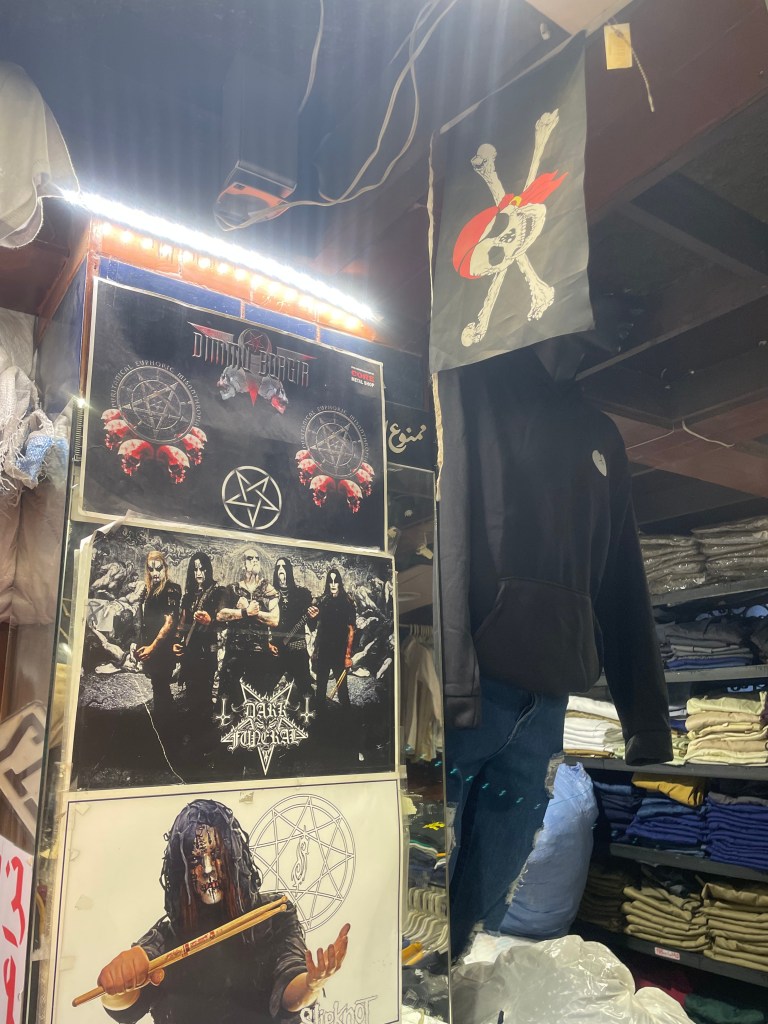
And when he did come home, he brought with him the kind of casual ethos that is signature to European life.“As a young boy I used to have all kinds of piercings and weird clothes, and many different types of people would come into New York because the store is next to a public health insurance building. I used to sit on the cash register and some of those people looked at me strangely, but my dad always encouraged me. He’s old but he has such a young spirit.”
Three decades onward, the store still receives families travelling all the way from cities including Tanta and Alexandria to shop. “It’s hard for a lot of people to afford the kind of clothes that they actually want to wear. Customers come in and they sometimes pray for me, they thank me for keeping prices in mind. I started this store because I wanted to do something that was both new and accessible to everyone. Clothes were expensive in Egypt back in the 80s, and everything was imported. People were struggling, and they still are, but we can try to ease that burden,” Khomaeis said.
By elevating local clothing which had a long-running tradition of being labelled as ‘common’ or ‘tacky’, Khomaeis reclaimed the narrative and spoke to the underbelly of Cairo. By perceiving fashion as something fluid– something moldable– he inadvertently laid out tracks for everything that defines the youthful Cairo subculture of today. His store is an early example of the same romanticization of old iconography, like street signs or kitsch fashion, that is now popular. ‘NEW YORK’ thereby marks a nostalgic transition from old to new without abandoning the old at all, resulting in a metamorphosis of everything that is intrinsically Cairene.

 fashion editor & content creator